Monday, May 17, 2010

Kappa Kappa Denmark

One of my closest friends in Denmark is an American girl named Tasha. She grew up in Nassau County, New York, the daughter of a Guyana-American (Muslim) father and an Indian-born (once Hindu, now Christian) mother. Tasha has two sisters, and the three of them are eerily similar in appearance, personality, and proclivity for shenanigans as TV-land’s 3 notoriously fun sisters, Kim, Khloe and Kourtney Kardashian of the eponymous reality show, Keeping up with the Kardashians. Tasha – living abroad in Denmark – would be Kim; little sister Nita —living the high life as a pharmaceutical drug rep in Miami— is wild-child sister Khloe; and big sister (and married mama) Lynn, back in NY, is the Kourtney-type.

In my book, they are the Kurry-dashians, on account of their maternal roots.

Tasha is my breath of fresh air as I try to carve out some semblance of a partially American (mostly Danish) life for myself in Copenhagen.

It isn’t easy, but we make it work.

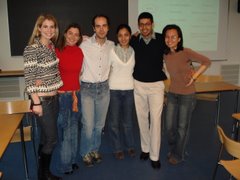
We get together for long gab-fests with two other American girls, Jenn and Kris, and our honorary “American” friend Ditte (who is 100% Danish, but likes Americans and is very international. So we let her into our American sorority). Ditte Holm thought her last name was too Danish, so she changed it to McHolm in a nod to her favorite burger joint and to be more accessible to the Scottish roommate she took into her flat (Andy McInroe). We didn’t know his name was Andy because Ditte only calls him Scotty, because you see, he’s from Scotland. So you get the picture – we’re a super international crowd (trying to be hipsters, ending up goobers).

Tasha Kardashian met Ditte McHolm when Ditte was 13-years-old and on holiday in Barbados. Ditte’s open-minded, very Danish parents encouraged young Ditte to explore the island and date! Tasha and her sisters, seizing on her long, flowing hair and killer, tight Danish bod, took little Ditte under their wings, for fear that the men of the island would exploit the naiveté of a Scandinavian blonde in a Caribbean land.

Fast forward many years later, Tasha is married to a Danish man, and Ditte is a smart and savvy Danish journalist cracking up her American friends with stories of her misadventures in dating. Ditte is Denmark’s Bridget Jones, in every possible way, on the hunt for her Colin Firth (but encountering mostly lecherous Hugh Grants).

Ditte is like our hilarious little sister. You always want to help her, you sometimes want to pay for her. You know she’s going to show up 30-minutes late to brunch with sunglasses and a hangover. But really, I think she’s the one showing us the ropes. I'm so glad we have her.

This is my sorority. Now you know the major players.

(to continue reading, click here)

Sunday, May 16, 2010

Part 2: Kappa Kappa Denmark - On Religion

(To read Part 1, go here)

My first year in Denmark, I was leery about making too many American friends. My Irish friend Carl advised me, early on, to steer clear of most international groups, for fear that I would be suggestible to the way their meet-ups often descend into whine-fests with participants singing the Battle Cry of the Foreigner: “It’s a Hard-Knock Life for Expatriates in Denmark!”

He wasn’t far off base. Often, you get a bunch of expats in a room in Denmark and the topic turns to how hard it is to: 1) learn Danish 2) make friends 3) ride a bike (that may just be a gripe of Americans, I’m not sure yet). We also often talk about 4) how expensive everything is in Denmark 5) how hit or miss healthcare is 6) how g*d-damn bloody rainy the weather is...7) how bad the service is in restaurants and cafes...and a host of other ‘issues.’ Sure, a lot of wine drinking and partying goes down too, but complaining can be a common thread among internationals getting together in Denmark.

Sometimes, my American sorority falls prey to this. But mostly, we try to problem-solve our way out of tight spots we each, individually, run into as immigrants in a foreign land – socially, linguistically, professionally. You name it.

Kris has helped me make peace that because I was born a Catholic, and, as far as I can tell, cannot wash my faith out of me, I don’t need to let it get to me so much, the fact that other people (Danes) are afraid of me for ‘having a religion.’ American sociologist Phil Zuckerman wrote in his book Society Without God (based on his year spent living in Denmark and Sweden) that he was told by a Danish pastor that “the word ‘God’ is one of the most embarrassing words you can say. You would rather go naked through the city than talk about God.”

Kris, unabashedly Catholic and raising a Catholic American/Danish daughter, helps me deal with this. Because this is a banner issue for me that unwittingly prevents me from fully integrating into Danish society. Not because I want to chat about God. I don’t. Not because I’m a devout Catholic (I’d prefer to be known as Jewish). Not because I want everyone to believe in G*d, I don’t want all of us to be the same. Not because I want everyone to be as mad as I am at the Catholic Church; most are. But simply because I want it to be okay to have a belief in something without it eliciting fear. Call me kooky, but I believe the world is richer for having many faiths in it. And this is not something to be afraid of. But I’m afraid of living in a country that is so afraid. I have a hard time being neutral on this one.

And if Denmark wants to live up to her ideals of being the most tolerant, open-minded European country (and that isn’t just hippie-dippy ‘kumbaya’ yarn), then she will extend those ideals to everyone. Atheists, Christians, Muslims, Skeptics, Jehovah’s Witnesses, Jews, Baha’is. Everyone. Kris is much more forgiving of her adopted 'countrymen' on this issue, and just lets it go.

But this is issue #something for me. I need people like her to help prop up my faith.

(To read more about my über-issues click here.)

Kappa Kappa Denmark: On language

(Part 3 of Kappa Kappa Denmark, Part 2 is here)

A common topic among foreigners is that thorny question of language and integration. This is an issue that I frequently discuss with American Tasha. For an introduction into Tasha, see here.

It took her about 3 years to become fully fluent in Danish. She speaks English at home with her husband, Danish with his parents, and a combination of Danish and English at work. I’ve gone to her, distressed, seeking advice on why I SUCK SO BADLY AT DANISH. If I ask my boyfriend why I suck so badly at Danish, he replies, “That’s a no-brainer. You’re lazy. You don’t practice.”

He is 100% correct. I don’t practice speaking Danish much anymore. I was committed to learning Danish my first two, two-and half-years in Denmark. Then, too many people (boyfriend included) pissed me off with their unyielding questions about why I didn’t speak Danish better, that I preemptively made the decision to not learn it (at least, that’s what my therapist Finn remarked: that I’ve “subconsciously decided to not learn Danish, for fearing of losing my Americanism”). Finn is a 70-something-year-old Dane who understands perhaps 15% of what I say, when I prattle on in English. But he has me pegged correctly! Guilty as charged.

My broken Danish has given way to too many giggles, too many “hvad siger du’s?” (what did you say?), too many “how long have you been in Denmark and you still can’t speak its?!?” that I've simply stopped trying. It sounds like I’m blaming everyone else, but I put the blame squarely on me and my hyper-sensitivities.

So, I blew the whistle and put myself on the bench. I will not play the game of Danish. And I’ll try to explain why. Here’s what Tasha and I came up with.

We are Americans (a Californian and a New Yorker). We grew up in a melting pot of mellifluous linguistic harmonies – a cheesy chorus of different dialects, accents and languages: Spanish, Russian, Polish, Mandarin, a little French here, a little German there. You can vote in a U.S. election in your choice of over 100 languages. And God Bless America for that.

I’ll give you an example of how I encounter a person in America who doesn’t speak English. Let’s take Angela, who hails from Mexico and does some work for my mom. I speak to her in a combination of Spanish, with a little English. I would never, ever, in a million years ask her why she hasn’t ‘learned English’. Such a question is beyond rude, and none of my business. So for the life of me, I can’t figure out why a Dane who I barely know asks me to my face why I’m not speaking to them in Danish. That I should know it “by now.” “That ‘it would help me so much to know it.” Not knowing that they are person #234 delivering this news.

The more I have been told that “I must learn Danish”, or that “the Key to my survival (i.e. integration into Denmark) is through Danish” the more I put on the brakes.

As Tasha explained it to me, in America, foreigners arrive at the decision (in however long time it takes them) as to whether or not learn English. They are rarely forced to learn English. A lot do learn English, eventually. And most who don’t speak a lick of English, when given the choice, would say “Sure, if I could take a pill and be fluent, that would be great!” Bottoms up.

But no one can force anyone to learn English, and becoming fluent is not a prerequisite for being granted residency in the U.S. (like it is in Denmark).

Immigrants in the U.S. are given options. Option A: Learn English, make friends, get a decent job. Option B: Don’t learn English, work in a place where you don’t need language skills (probably an unsavory job), make friends who speak your language. Option C: Learn English when you are ready, in your own time and on your own terms, adapt jobs accordingly. We’ll be here, eager to help you, no matter which option you take. The decision is squarely yours.

In Denmark I have been told by my boyfriend and key Danish advisors (not including Ditte), that I have one option: Learn Danish! Otherwise, I will not have friends, I will have a tough time keeping a decent job, and they will pound me with questions until I go crying back to where I came from.

As Tasha explained it, for rebellious, freedom-fighting “Boston-Tea-Party-loving Americans” like us, to be told that we have one, lonely option, we freeze.

As she puts it, it’s like being forced to walk down a tunnel. Where we are used to having 3 or 4 options of tunnels, there’s now only one we must cross. So we throw up our arms, and reach for the walls – building bodily barricades in the form of instructing an otherwise intelligent brain to tune out all Danish.

When I hear Danish around me now – at work, on the train, or at a cocktail party – my brain goes on vacation. I tell myself, “Take a breather now, and get back on the bench. Let them speak their Swahili, don’t concern yourself with it. You alien, you immigrant. Get another martini.”

I stumble home drunk on my own pride.

So I don’t concern myself with language any longer.

This is me, being an American, and playing by my own rules of the game. I’ve carved out another tunnel of an Option for myself. It’s not an easy channel. It has made life harder for me and more alienating in every possible way. On Tuesday I was ejected from an important meeting with a client because they wanted to conduct the meeting in Danish/Swedish. So I took the walk of shame back to my desk.

A normal person – dejected and yet provoked – would have tearfully taken out her “Learn Danish!” flashcards and gotten down to business.

I didn’t. I can’t leave the cavernous tunnel of my choosing. It was my decision to move to Denmark and to take the path less traveled.

One day I’ll arrive at the forest, fluent or not. I don’t know. But hopefully getting there on my own path and my own terms will have made some difference.

Sunday, February 14, 2010

A Valentine’s Day Poem


There are two countries that I love very much.

You probably could guess them: America and

Sweden.

I’m kidding with the second one.

I like to be a stinker.

Nothing against Sweden — it's superb over there

But my heart belongs to Denmark.


The quickest way to piss off a Dane is to tell them

You’re obsessed with Sweden.

That’s sort of like moving to South Dakota,

& telling the folks there that you’re obsessed with

North Dakota.

When it’s really all the same.

I have a hard time telling the Danes that I love

Their country.

It’s like a 15-year-old trying to tell her mom that

She loves her. True as it is, it’s hard.

She’s pissed you off too many times.

So you mumble the words to her,

“Yeah, I love you Denmark. Whatever.”

“I don’t know how to live without you.

But sometimes you’re so hard on me.”


“Sorry for calling you those names, and telling you to

Suck it.

Sometimes I misbehave just to get your

Attention.

I’m callous and bitchy, and you’re an easy

Target. You just flash me back your tan smile,

Then lower your head. You’re way too polite

And modest for me."


"You don’t let me get away with my old tricks.

You’re so fresh and plucky beneath your

Shy demeanor. I can’t get close to you because

I don’t get you.”


The truth is, sometimes I feel like a girl without a

Country. That’s how Americans perceive

Canadians: “90% of You live within 90 miles of our US

Border, but you’re not Americans. So what are you?”

I use words that are elitist and annoying, like hubris

To describe that tendency of ours.


I want to option a script for the Coen brothers called

“No Country for Old Menacing Chicks” but I don’t know

What it means, to option a script.


I like to make up words, like perplexion...which is when

You have a perplexed complexion; red, ruddy cheeks that

Hold a contemplative position seconds longer than

They should.

Like this poem.


Happy Valentine’s Day, Denmark.

Will You Be Mine?

XO

Wednesday, November 25, 2009

Blogging the Blues


A POEM

What does homesickness taste like?

It tastes like pink cotton candy. You sink your teeth into it,
and experience something sweet and luscious. You savor the
cosmopolitan world around you; that you get to live in right
now. You smile because you have an army of a family far
away that you get to miss.

It gives you a toothache. So you curl your lip to taste
something salty escaping your eyes. You live with it. You
want to throw the candy floss away, but it’s never that easy.

What does homesickness sound like?

It sounds like white noise. Like a booming, hollow gasp that
trickles down into a pin drop. It echoes throughout a
cluttered apartment. It sounds like a phone ringing that never
gets answered. It’s the sound of an idiot foreigner butchering
the word rød, and calling her red friend an ass. It’s the
vibrato of an adult whining like a little girl, to the man she
loves the most.

It’s the hum of a half-minute conversation with pops about
the weather, while 'The Rumour Said Fire' sings a lullaby
in your ear.

What does homesickness look like?

It looks like hackneyed poems...that puff off the page like
jacked-up songs that would make Diane Warren blush.
It struts like slutty leather pants with a gold zipper,
purchased with cash. It's as sticky and scarlet as Dior lip gloss.

It is huddling under the blanket devouring books about a
mormon teen in love with a vampire. It’s the sight of a
refrigerator filled with camembert and brie.

That’s all.

What does homesickness smell like?

It smells like a fatty pork loin dissected by the cunning
fingers of someone who wants to keep kosher.

It's the scent of the sandalwood in your mom’s Hanae Mori
butterfly perfume. It wafts like Betty Crocker red velvet
cupcakes that do the trick. With tahitian vanilla frosting. It
has the essence of aged olive oil from Modena made by an
Italian amore. You can pick up a trail of witch hazel and
alcohol antiseptics slathered on chapped hands, taking a
beating.

What does homesickness feel like?

It feels like Gaultier suspenders worn too tight, so you walk
around unfashionably hunched over. It feels like a
misaligned jaw. Something askew, the toothache moves
south in the body, settling down in the chest. The pain is a
lonesome twister in the cavity where your heart used to beat.
You miss; you bend over laughing, you ache.

A tumbleweed blows through your body. Some days the pain
is a dusty pit in your belly. Every day the pit grows a bit
bigger. And the seed gets taller, strengthened by the blissful
absence of the one person whose should bring water to
your garden. And the fact that your pain is something this
person is okay with, makes the agony you feel that much
harder.

♥
CT

Monday, November 16, 2009

The Amazing Fleggaard!

Just across Germany's northern-most border with Denmark you’ll find an incredible superstore called Fleggaard. There, you can buy everything you need – tubs of gummi bears, cases of wine, industrial strength dishwashing soap – at prices 30% cheaper than you’ll find in Denmark. It is Denmark's Costco, packaged as a German loophole.

Though the store is in Germany, it is owned by Danes and exists solely to help Danes avoid the high taxes on goods they are forced to pay in their lil' island-country. If you’re having a party in Copenhagen, it’s smart and common to make the 4-hour schlep just across the border to Germany to buy all your liquor (after all, parties are expensive, with all the drinking that goes down). So, Danes will drive for 2 hours, take a ferry ride, drive another 2 hours, all to SAVE oodles of cash.

So, as Fleggaard is just over the line between Germany and Denmark the company slogan goes “Lige Over Grænsen” which translates to “Just over the line” in Danish.

Their advertising agency has taken that mantra to heart, with a series of gorgeous ads featuring scantily clad models that are 'just over the line.' The first film (below) included a plane full of stunning red-bikini-wearing models who, topless, parachute out of an airplane.

The 100+ women do stunts in the air – while free-falling -- holding hands to spell out “Half-off on Dishwasher soap at Fleggaard.”

You’d be hard-pressed to find a man in Denmark who hasn’t seen and fallen in love with that commercial. It was geared strictly to men.

Last week, Fleggaard released their tasty treat for the women. This ‘music video’ (above) features a zeppelin plane filled with beautifully buff male models who enter a cavernous, womenly-shaped landscape.

Like the one before it, it is “lige over grænsen” – just over the line. And it's hysterical. Denmark's most fearless and talented commercial director, Peter Harton, outdid himself this time. He should be bringing his magic to New York City or Los Angeles some time in the future.

Enjoy!

"Lige Over Grænsen"

(Don't watch the video below if you're an easily offended: feminist; religious person; under the age of 16; or a gay male. This is purely gratuitous T & A that shows creative & beautiful Denmark, in all it's glory).